Secure, Manage, and Verify Digital Documents — The Smarter Way.

With ProofEasy, every file becomes tamper-proof and instantly verifiable.
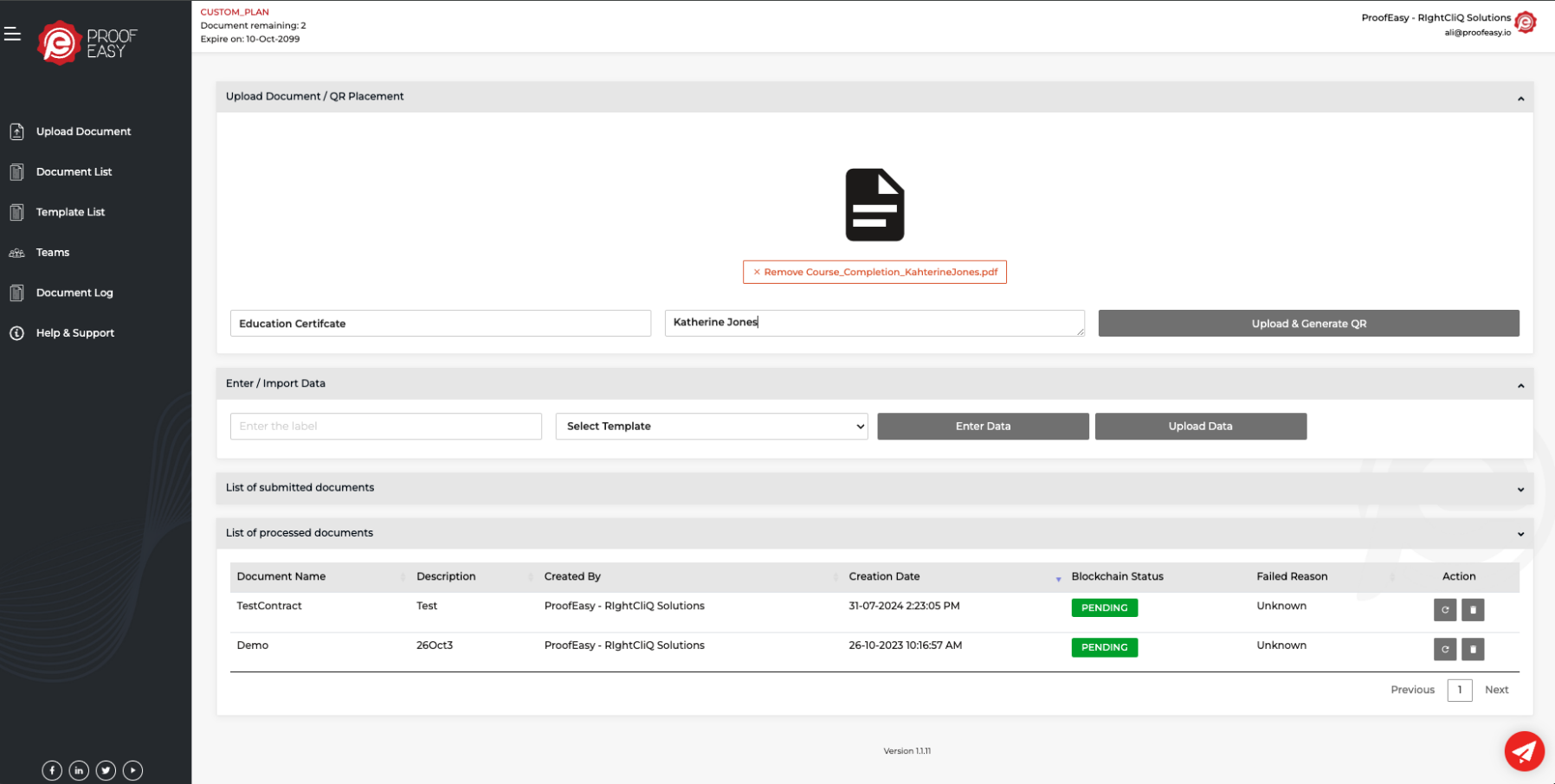

image12

The AI Age Broke Trust In Digital Documents.

ProofEasy brings it back in 3 steps

Upload certificate, report, or contract.

Protect it with blockchain and a QR code.

Authenticate through QR scan to verify proof.

Chosen By Global Leaders

Not All Documents Are Created Secure

The rise of AI has eroded trust in document security. From fragile paper files to editable digital PDFs, traditional formats are easily tampered with—here’s how they compare to a ProofEasy-secured document.

Evaluation Criteria

Paper Documents

Traditional Digital Documents

Evaluation Criteria

Security

Easily damaged, lost, or forged

Can be copied, altered, or tampered with

Locked on blockchain and immutable

Verification

Manual, slow, and error-prone

Limited, often manual

QR and blockchain allow instant validation

QR and blockchain allow instant validation

High storage costs and difficult to organize at scale

Risk of unauthorized edits and duplication

Seamless integration into enterprise systems

Tracking

No reliable tracking of usage

Limited visibility into authenticity

Real-time logs and lifetime tracking

Reliability Begins With Security—And Proofeasy Delivers Both.

The ProofEasy Advantage

Happy Using ProofEasy
image17

1

Boost Customer Confidence

Tamper-proof and verifiable — blockchain-backed security ensures every document is authentic.
image18

2

Verification Made Simple

Instant and universal — QR codes enable verification on any device, no apps required.
image19

3

Save Time & Cut Costs

Built to scale — secure millions of documents instantly, eliminating manual checks.
image20

4

Strengthen Brand Reputation

Seamless and branded — customers verify documents directly on your platform, reinforcing credibility.
image21

5

Enterprise-Ready Integration

Customizable and flexible — white-label verification, OTP access, and APIs let you embed ProofEasy into your systems.

Successes In Numbers

2600+ ProofEasy Users Globally

2600+ Users

60,000+ Documents secured Using ProofEasy

60,000+ Documents

ProofEasy used in 10+ Countries

10+ Countries

ProofEasy Across Industries

image33

Education

Diplomas, transcripts, and Ds. Authentic credentials vith no fakes or re-issues.
image34

Compliance & Audit

Audit reports, regulatory documents. Immutable audit trails regulators can rely on.
image35

HR & Payroll

Offer letters. Payslips. Employment records. Instantly verifiable and trusted.
image36

Real Estate

Property records, title deeds, transfers & agreements. Verifiable ownership and tamper-proof transactions.
image37

BFSI

Loan approvals, insurance policies, KYC and transaction documents. Regulation-compliant, verifiable and tamper-proof records.
image38

Healthcare

Medical records, lab results, prescriptions and other patient information. Trusted, verifiable and secure across providers.

Frequently Asked Questions

Why Do We Need ProofEasy?
ProofEasy is a Software-as-a-Service (SaaS) web application that allows individuals and organizations to generate instantly verifiable proof of authentication of any document, like audit reports, contracts or certificates.
Maintaining records, issuing credentials, awarding certificates, submitting proofs for financial and business purposes are some of the document needs that are omnipresent across multiple-sectors. Often the traditional methods in which these documents are handled leads to fraudulent activities resulting in financial loss and integrity. ProofEasy helps organizations promote and prove the validity of their documents by cryptographic hashing the digital records and placing them on a blockchain, which is tamper-proof, and shareable.
Blockchain-based products are increasingly used across multiple business sectors, because of its decentralized nature. This can be a vibrant technology enabler to overcome third-parties for document verification systems. Blockchain’s architecture supports many types of transactions – logging an event, signing a document, voting, allocating energy between parties, managing a supply chain etc. Our market studies and experience result in significant cost savings, efficiency, security, and compliance compared to traditional systems and business processes.
ProofEasy stored the documents on secure AWS servers. The documents can be stored on your organization servers. Please refer to our Custom Integration section for more details.
With a simple drag-and-drop action, users can upload various document formats and produce a shareable document, which can be verified by receivers anytime, anywhere. When a registered user uploads a document in ProofEasy, it is digitized using the patented VeriDoc Global (VDG) protocol. The digitization of the document involves, extracting data from the document and creating a unique hash value. This hash value is placed on the blockchain and at the same time recorded into a unique QR code, which is then added on the digitized document. This document is safely secured in ProofEasy server. By scanning the ProofEasy QR code, anyone can uniquely identify the content of the original document created by the issuer and verify the data integrity.

In simple terms, hashing means taking an input string of any length (data from your document) and giving out an output of a fixed length. It is also called as a message digest. Here is a list of attributes associated with hashing:

  • Any known input must always produce one known output.
  • Once hashing has been done, it cannot be reversed, and it is impossible to go from the output to the input.
 

If an input is modified, the initially generated hash will not match. In ProofEasy, hash plays a significant role in detecting fraud. For example, someone makes even a slight change in the document which is already protected with ProofEasy. In that case, the hash will no longer match, protecting you against fraudulent tampering of your document.

You need to upload the document again in ProofEasy and generate a new QR code embedded document. This ensures a highly secure file transfer system.
VDG protocol based ProofEasy verification will help you in detecting the fraud. Scanning the QR code will show the original content, which will not match with the tampered document.
As the name suggests, blockchain is the chain of digital blocks that contain records of transactions. The consensus algorithm of the blockchain is designed in a way such that each block is connected to all the blocks before and after it. It makes it difficult to tamper with a single record. The records on any blockchain are also secured by cryptography. The participants have their private keys assigned to the transactions they made, which also acts as a digital signature. If that record is tampered with, then the signature will become invalid, and the peer network will know right away about the same.
No, it is free. ProofEasy helps eliminate any third party, in turn removing the tedious process involving record-keeping and its verification. It helps redefine your systems to boost their operational and functional transparency.
With the expanding blockchain market, it is sometimes tricky for enterprises to analyze the vast system of verification depending upon the databases, cloud and business environment, etc. To help ease this process, ProofEasy has introduced the ‘Immutability’ factor to the whole process. It helps eliminate any third party, in turn removing the tedious process involving record-keeping and its verification. It helps redefine your systems to boost their operational and functional transparency.
Yes, the verification process will maintain the branding of that company. When any company secures its document using ProofEasy, the record is then opened up inside its website. In the process, blockchain verification is maintained. It is one of the critical steps for the companies as they want to bring traffic to the website while maintaining their credibility.
Companies deal with a lot of confidential data which cannot be made accessible to all. To ensure the security of the same, only the recipient who possesses the code can view it unless the recipient shares it. Hence, QR codes restrict the permission regarding who can participate and in what capacity. ProofEasy uses a patented QR code that cannot be duplicated when created on a given document.
ProofEasy can help secure documents related to various industries. ProofEasy helps secure any kind of document that needs validation by eliminating any third party. An example of a company that uses ProofEasy is the Will and Estate/property industry. Some of the documents that can be secured are Certificates, Insurance policies, Real Estate documents, Financial documents, Legal and Contractual Documents, Will, and estate documents.
Yes. In ProofEasy, the accepted documents are PDF files, JPG, JPEG, and PNG files. However, the maximum file size cannot be more than 25MB.
To help ease the process of document verification and security, considering the small, midterm, and large enterprises, ProofEasy has included the ‘Immutability’ factor to the whole process. ProofEasy helps eliminate any third party, in turn removing the tedious process involving record-keeping and its verification. ProofEasy also uses blockchain technology to ensure tamper-proof documentation, because of which the developers can quickly provide security to the documents. It helps redefine your systems to boost their operational and functional transparency.

ProofEasy helps secure any kind of document that needs validation by eliminating any third party. Some of the industries are:

  • Real Estate: ProofEasy ensures a safe environment for distributing and exchanging documents, thus making them more accessible. The unique QR code generated ensures that the blockchain ID is only accessible to those with the original QR code.
  • Financial Institutions: ProofEasy uses patented QR codes and technology to provide secure and safe access to the documents. It helps tackle challenges like reporting to stakeholders, project management, and compliance.
  • Legal and Contractual: ProofEasy simplifies the process of validating proofs and ensuring verification. It helps keep up with employee satisfaction while providing the best satisfaction for the firm’s documents.
  • Will and Estate: With the help of the patented QR code, one cannot duplicate the submitted document. Two options are always available to the owner, irrespective of the blockchain’s touchpoint on the document. Options include validating the document by cross-checking proofs and immediately responding to all users if the documents are being tampered with.
  • Insurance Policies: ProofEasy helps secure one’s insurance policy with the help of the patented QR code and the blockchain policy; one cannot interfere with the documents.
  • Certificates: ProofEasy also uses blockchain technology to ensure tamper-proof documentation, because of which the developers can quickly provide security to the documents.
Yes, QR codes are legal. Both private and public sector organizations use QR Codes to engage their audiences on a global scale. ProofEasy’s QR codes and blockchain technology are a must to ensure quick and transparent transactions and exchanges.
ProofEsay uses a patented QR code for security, which cannot be duplicated when generated on a submitted document. The QR code contains a link to the VeriDoc Global verification engine for that specific document. The verification engine authenticates the hash on the blockchain and displays the original document secured using the ProofEasy platform.
Yes. ProofEasy can be integrated with the rest of your applications with the help of API. Our API integration platform allows businesses to leverage existing application functions with other systems and applications. This ensures seamless connectivity and enhances the ease of sharing and secure embedding of information and data between various systems.

Give Your Documents The Security Of Blockchain Today

Get Started With Digital Adoption Today
image11